Myanmar Bag Tariff 2026: 17.6% US Duty

USITC 2026 HTS Rev. 17, checked line by line: Myanmar-origin bags pay 17.6% MFN duty only, no Section 301 add-on. Vietnam pays 30.1%, China 55.1%. HTS 4202 lines by category, duty-paid index math, what changed in February and July 2026, and how to verify every figure yourself.
Myanmar-Made Bags Enter the US at 17.6% Base Duty Only — A 2026 Tariff Guide for Backpack and Bag Sourcing
Verified line by line against the USITC 2026 Harmonized Tariff Schedule — the current numbers, what changed in February and July, and how to check every figure yourself
"Is Myanmar really outside Section 301? Every other country on our shortlist got hit in July."
That has been the first question from almost every US buyer we have spoken with since the summer — usually with a landed-cost spreadsheet already open on the other screen.
The short answer is yes. This article is the long answer, with the HTS lines to prove it.
The Short Answer: 17.6%, and Nothing Else
Myanmar-origin bags enter the United States at the Most Favored Nation (MFN) base rate only. No Section 301 tariff, no reciprocal tariff, and no other additional duty currently applies to goods of Myanmar origin. We verified this line by line against the official USITC 2026 Harmonized Tariff Schedule, Revision 17, and against the July 2026 Section 301 action, which names 60 economies and does not include Myanmar.※1 ※2
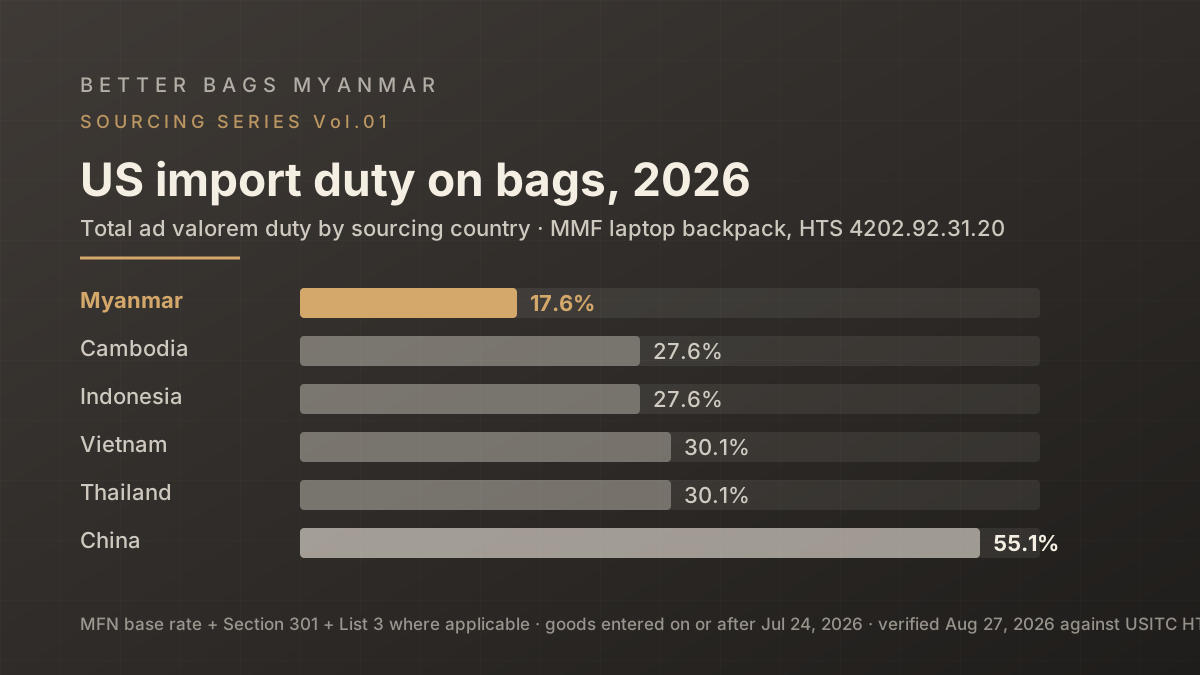
Here is the total ad valorem duty on man-made-fiber (MMF) tech bags, for goods entered on or after July 24, 2026. The reference construction is an MMF laptop backpack under HTS 4202.92.31.20 — the highest-volume category profile for most of the brands we work with.
| Sourcing country | Total US import duty | How it is built |
|---|---|---|
| Myanmar | 17.6% | MFN base rate only, no additions |
| Cambodia | 27.6% | 17.6% MFN + 10% Section 301 |
| Indonesia | 27.6% | 17.6% MFN + 10% Section 301 |
| Vietnam | 30.1% | 17.6% MFN + 12.5% Section 301 |
| Thailand | 30.1% | 17.6% MFN + 12.5% Section 301 |
| China | 55.1% | 17.6% MFN + 25% List 3 + 12.5% Section 301 |
Two things stand out. First, the base rate is identical everywhere: 17.6% is what the bag itself carries, regardless of origin. Second, everything above 17.6% is an origin-specific addition — and Myanmar has none.
What Changed in 2026
If you last checked Myanmar duty rates in 2025, your numbers are out of date. Two events reset the table this year.
February: the IEEPA tariffs were struck down. Under the former IEEPA-based tariffs, Myanmar-origin goods carried a 40% rate. On February 20, 2026, the US Supreme Court ruled in Learning Resources, Inc. v. Trump that those duties were unlawful, and the implementing order terminated IEEPA duties effective February 24, 2026 (CBP CSMS #67834313).※3 From that date, Myanmar dropped back to the MFN base rate.
July: the new Section 301 action landed — on 60 economies, not on Myanmar. The Section 301 action published by USTR at 91 FR 47318 took effect on July 24, 2026. It adds 10% or 12.5% to goods from 60 economies, including Vietnam, Cambodia, Thailand, Indonesia, and China. Myanmar is not on the list.※2
China keeps List 3 on top. In addition to the new 12.5%, China-origin goods under heading 4202 still carry the Section 301 List 3 rate of 25%. That is how a China-made laptop backpack reaches 55.1%.
The practical result: in the space of five months, Myanmar went from one of the highest additional-duty origins in the region to the only one of the six origins above with no additional duty at all — a 12.5-point gap in Myanmar's favor against Vietnam, and 37.5 points against China.
Category by Category: HTS Lines and Total Duty
Bags are not a single tariff line. Below are the four categories that make up most tech and travel bag programs, with the HTS classification we use for each and the total duty by origin. Identical constructions are assumed throughout — man-made-fiber outer — because that is what keeps the MFN base rate at 17.6% across the board.
| Category | HTS line | US MFN base | Myanmar total | Cambodia · Indonesia | Vietnam · Thailand | China total |
|---|---|---|---|---|---|---|
| Laptop backpacks | 4202.92.31.20 | 17.6% | 17.6% | 27.6% | 30.1% | 55.1% |
| Laptop briefcases and messengers | 4202.12.81.30 | 17.6% | 17.6% | 27.6% | 30.1% | 55.1% |
| Camera bags and camera backpacks | 4202.92.91.00 | 17.6% | 17.6% | 27.6% | 30.1% | 55.1% |
| Travel and duffel bags (non-backpack) | 4202.92.31.31 | 17.6% | 17.6% | 27.6% | 30.1% | 55.1% |
Classification is construction-dependent. A leather outer, a different closure, or a bag that straddles two categories can land on a different line with a different base rate. Treat the table as the starting point and confirm the final classification at entry with a licensed customs broker.
Same Bag, Duty-Paid: An Indexed Comparison
Tariff percentages only matter once they are applied to a price, so here is the comparison the way our clients actually run it — indexed, so no absolute prices are needed.
Set China and Vietnam FOB at 100 for an identical construction; for the same bag, the two are typically at parity. Our standing quote basis runs roughly 10% below that, at about 90 — confirmed SKU by SKU at quotation. Apply the official duty rates from the table above. Freight is excluded, and the Merchandise Processing Fee (0.3464%) and Harbor Maintenance Fee (0.125%) are the same for every origin, so they drop out of the comparison.※4
| Origin | FOB index | US duty rate (official) | Duty-paid index | vs. Myanmar |
|---|---|---|---|---|
| Myanmar (Better Bags) | ≈90 | 17.6% | ≈106 | — |
| Vietnam | 100 | 30.1% | ≈130 | +23% |
| China | 100 | 55.1% | ≈155 | +47% |
Duty-paid index = FOB index × (1 + duty rate). Read the other way around:
- Myanmar lands about 19% below Vietnam, duty-paid, for the same construction.
- Myanmar lands about 32% below China, duty-paid, for the same construction.
Even if you set the FOB advantage aside entirely and assume parity at 100, the tariff alone puts Myanmar at ≈118 against Vietnam's ≈130 and China's ≈155. The FOB figures are indicative and are confirmed per SKU at quotation; the duty rates are official.
Beyond the Tariff: Two Countries, One Workflow
A tariff gap is a reason to look at Myanmar. It is not, on its own, a reason to move a program there. The questions that decide that are about development speed, capacity, and whether the quality system holds up without a buyer on site.
Our answer to the first is structural. Design and rapid sampling happen at our center in Qingdao, China, where fabric, webbing, hardware, and trim suppliers are within a day's drive and a dedicated project team turns samples in about two weeks. Volume production happens at the Yangon factory. One workflow, two countries: the development pace of a China supply base, the origin and duty of a Myanmar line.
On quality, we would rather show than tell. Two earlier articles document the systems that run every day on the Yangon floor:
- 【Quality Series Vol.01】 We Don't Let a Single Needle Slip — the needle-inventory ledger and 100% X-ray screening behind every shipment.
- 【Quality Series Vol.02】 A Second Look Through Third-Party Eyes — more than ten years of independent inspection with I-pack.
Factory Snapshot
| 2003 | OEM/ODM bag maker since — Yangon production, China design and sampling center |
| 600+ | team members at the Yangon factory |
| 50,000+ | pieces monthly capacity |
| 1,500 | MOQ per style and color |
| ~2 weeks | sampling lead time, dedicated project team |
| 15+ years | continuous partnership with anello (Japan) |
| 100% | end-of-line inspection, third-party verified |
| 2 | countries, one workflow: design and rapid sampling in China, volume production in Myanmar |
Selected brand experience: anello · Legato Largo · New Balance · Converse · Fila · ONWARD.
Categories we build: laptop and business backpacks · camera bags · briefcases and messengers · travel and duffel bags · sleeves and organizers · anti-theft and commuter bags · recycled-material constructions.
If you would rather see the floor than read about it, One Day at Our Yangon Factory walks through it from the 7:30 start to the 6:00 close.
How to Verify These Numbers Yourself
We would encourage every buyer to check, not trust. It takes about fifteen minutes.
- Base rate. Open the USITC Harmonized Tariff Schedule at hts.usitc.gov and look up the Chapter 42 line for your construction — for example 4202.92.31.20 for an MMF laptop backpack. The "General" column is the MFN rate.
- Additional duties. In the same schedule, Chapter 99 is where origin-specific additions live. The July 2026 Section 301 headings are 9903.05.20 through 9903.05.84; the China List 3 heading for 4202 goods is 9903.88.03. Check whether your origin country appears under any of them.※1
- The source documents. The Section 301 action is USTR's Notice of Actions in Section 301 Investigations, 91 FR 47318 (July 28, 2026; effective July 24, 2026).※2 The end of the IEEPA duties is Learning Resources, Inc. v. Trump (February 20, 2026) and CBP CSMS #67834313.※3
- Your broker. Classification is construction-dependent, and rates change. Have a licensed customs broker confirm the line and the rate at time of entry.
Five Questions US Buyers Ask About Myanmar Duty
| The question | Our answer |
|---|---|
| "Is Myanmar on the July 2026 Section 301 list?" | No. The action at 91 FR 47318 names 60 economies. Vietnam, Cambodia, Thailand, Indonesia, and China are on it; Myanmar is not. |
| "Weren't Myanmar goods at 40% not long ago?" | Yes, under the former IEEPA tariffs. Those were struck down by the Supreme Court on February 20, 2026 and terminated on February 24, 2026. Myanmar has been at the 17.6% MFN base rate since. |
| "Are there other fees on top of the 17.6%?" | The Merchandise Processing Fee (0.3464%) and Harbor Maintenance Fee (0.125%) apply — but equally to every origin, so they do not change the comparison. Freight and insurance are separate. |
| "Could my bag fall under a different HTS line?" | It can. Classification depends on construction — outer material, whether it is a backpack, briefcase, or travel bag, and other details. Our tables assume an MMF outer. Confirm the line with a licensed broker before finalizing costing. |
| "What happens if the rates change?" | The figures here were verified on August 27, 2026 and are subject to change. We will update this article and its modification date when they do. Ask us for the current brief before you lock in a landed-cost model. |
Moving a Product to Myanmar? Send Us the Sample
The fastest way to see what a Myanmar line does to your landed cost is not a spreadsheet. It is a bag.
Pick any SKU you are considering re-sourcing. We will counter-develop it at our Qingdao design center and come back with FOB pricing from our Yangon line, so that you can run the duty-paid comparison above on your own construction, not a reference one.
For shipments from the US, we use a consolidation point in Seoul; arrivals are forwarded to Qingdao the same day, which adds about one to two days compared with shipping direct. Contact us for the current shipping address. Once the sample ships, send us the tracking number and we will follow it through to arrival.
Get in Touch
Whether you want the latest version of the tariff brief, an FOB quote on a specific construction, or a walk through the Yangon floor over video, please don't hesitate to reach out.
Sources
- ※1 USITC, 2026 Harmonized Tariff Schedule of the United States, Revision 17, hts.usitc.gov — Chapter 42 rates; Chapter 99 headings 9903.05.20 through 9903.05.84 and 9903.88.03.
- ※2 USTR, Notice of Actions in Section 301 Investigations, 91 FR 47318 (July 28, 2026; effective July 24, 2026).
- ※3 Learning Resources, Inc. v. Trump, 607 U.S. ___ (February 20, 2026), and the implementing order terminating IEEPA duties, CBP CSMS #67834313.
- ※4 Merchandise Processing Fee (0.3464%) and Harbor Maintenance Fee (0.125%) apply equally to all origins.
Disclaimer
Duty figures in this article apply per the official USITC 2026 HTS Revision 17 as verified on August 27, 2026, and are subject to change. Classification is construction-dependent; confirm classification and rates at time of entry with a licensed customs broker. FOB index figures are indicative and are confirmed per SKU at quotation. This article is general information, not customs or legal advice.
Related Articles
【Quality Series】
- 【Vol.01】 We Don't Let a Single Needle Slip — The Needle-Control System at the Better Bags Myanmar Factory
- 【Vol.02】 A Second Look Through Third-Party Eyes — Delivering "100% Japanese Quality" on Myanmar Shipments with I-pack
【Factory Series】
About the Author
As the next-generation leader of Better Bags — a family-owned manufacturer with global vision — I draw upon more than 8 years of study and professional experience in Pennsylvania, United States. Being an alumnus of Penn State University and Carnegie Mellon University, I am proud to bring proven international expertise as well as cross-cultural communication skills to our clients and partners. My mission is to bridge the best of East and West, ensuring every partner enjoys premium products, seamless project communication, and reliable after-sales support — no matter where you are in the world.