Ni una sola aguja se nos escapa — El sistema de control de agujas rotas de la fábrica Better Bags Myanmar

Acercar a cero el riesgo más temido en la fabricación de bolsos: la contaminación por fragmentos de una aguja rota. Presentamos al completo el sistema de control de agujas rotas de la fábrica Better Bags Myanmar: el libro de registro de inventario de agujas, el detector de agujas X-ray Fjade y la conservación de registros durante 5 años — el engranaje que sostiene la "calidad japonesa".
Ni una sola aguja se nos escapa — El sistema de control de agujas rotas de la fábrica Better Bags Myanmar
"¿Qué es el control de agujas rotas?" — Guía completa de la defensa en dos capas de nuestra fábrica en Myanmar: del libro de registro de inventario de agujas al detector de agujas X-ray y la conservación de registros
"¿Y si un fragmento de una aguja rota acabara en la costura de uno de nuestros productos…?"
Quien se dedica a la compra de bolsos probablemente haya sentido ese escalofrío en la espalda al menos una vez.
Para acercar ese "y si" lo más posible a cero, en Better Bags Myanmar llevamos más de 20 años puliendo un mismo sistema.
Para empezar — Por qué el control de agujas rotas importa tanto
En una fábrica de costura se usan cientos de agujas cada día. Si una de esas agujas, que normalmente nadie ve, se rompe, y un fragmento acaba dentro de la costura de un producto terminado…
Una lesión en el dedo o en la piel del usuario final. La pérdida de confianza en la marca que traen consigo una retirada del mercado y el desecho del producto. Y el riesgo de indemnización bajo la Ley de Responsabilidad por Productos de Japón (Ley PL).※1
Para las marcas japonesas que trabajan con bolsos, carteras escolares infantiles y mochilas escolares, la "contaminación cero por objetos extraños" es un mínimo innegociable.
De hecho, las normas ST de la Asociación Japonesa del Juguete※2 y las especificaciones de entrega de muchas cadenas minoristas lo dejan por escrito, como condición comercial, en no pocos casos: conservar el libro de registro de control de agujas rotas e inspeccionar con X-ray todas las piezas.
En Better Bags Myanmar hemos caminado junto al mercado japonés durante más de 20 años desde nuestra fundación, y seguimos trabajando para acercar físicamente a cero ese "riesgo invisible", tanto en los sistemas como en los registros.
Las 5 preocupaciones que más escuchamos de nuestros clientes
Reunimos en 5 ejemplos representativos las preguntas y preocupaciones sobre agujas rotas y contaminación por objetos extraños que más escuchamos de los clientes japoneses en una primera reunión, cada una acompañada de nuestra respuesta.
| La preocupación del cliente | Nuestra respuesta |
|---|---|
| "¿De verdad una fábrica en China o en Myanmar puede gestionar las cosas con este nivel de detalle?" | El libro de registro de inventario de agujas es un formato que hemos pulido durante 20 años junto con nuestros clientes japoneses. La fábrica de Myanmar opera exactamente con ese mismo formato. |
| "Si una aguja se rompe, ¿de verdad pueden recuperar hasta el último fragmento?" | Toda la línea se suma a la búsqueda ese mismo día, y la jornada no termina hasta reunir todos los fragmentos. Nuestra regla es firme: cualquier descuadre en la conciliación debe resolverse el mismo día. |
| "¿La inspección X-ray se hace en todas las piezas o por muestreo?" | En todas las piezas: 100%. 2 máquinas en la fábrica de Myanmar (una de ellas una Fjade SECUT-5030D) + 1 detector X-ray en nuestra fábrica de Shandong, China; todo lo que enviamos pasa obligatoriamente por ellas. |
| "¿Cuántos años conservan los registros de control?" | Vinculados por lote, durante 5 años o más. Se conservan de modo que una auditoría de terceros, o una investigación retroactiva ante un reclamo de mercado, pueda reconstruirse solo con los documentos. |
| "¿Atienden BSCI / SEDEX / auditorías propias de cada empresa?" | Sí. Consulta de registros, visita a las instalaciones, ejercicios adicionales de verificación: todo disponible con solicitud previa. |
Si tienen otras preguntas, los invitamos a leer el artículo completo y a contactarnos desde el enlace del final.
Sobre un tema afín: nuestro sistema de doble verificación con inspección de terceros →
Nuestra defensa en dos capas — El libro de registro y el X-ray
A grandes rasgos, hay dos maneras de evitar que una aguja contamine un producto:
- Evitar que ocurra: controlar con rigor cada una de las agujas en uso y recuperar "siempre, en el propio taller" los fragmentos de cualquier aguja rota.
- No dejarlo pasar: aunque llegara a ocurrir, realizar una verificación final del 100% con el detector de agujas X-ray antes del envío.
Operamos estas dos vías como un único sistema de dos capas: el libro de registro y el X-ray.
Por qué dos capas
En teoría, no existe en el mundo un sistema de inspección que pueda declararse "riesgo cero". Pero al verificar de forma independiente con dos métodos basados en principios distintos, la probabilidad de que algo se escape no baja por suma, sino que cae de forma multiplicativa. Ese es el sentido de las dos capas.
Primera capa: el libro de registro de inventario de agujas — Una línea al día, ni una aguja fuera de lugar
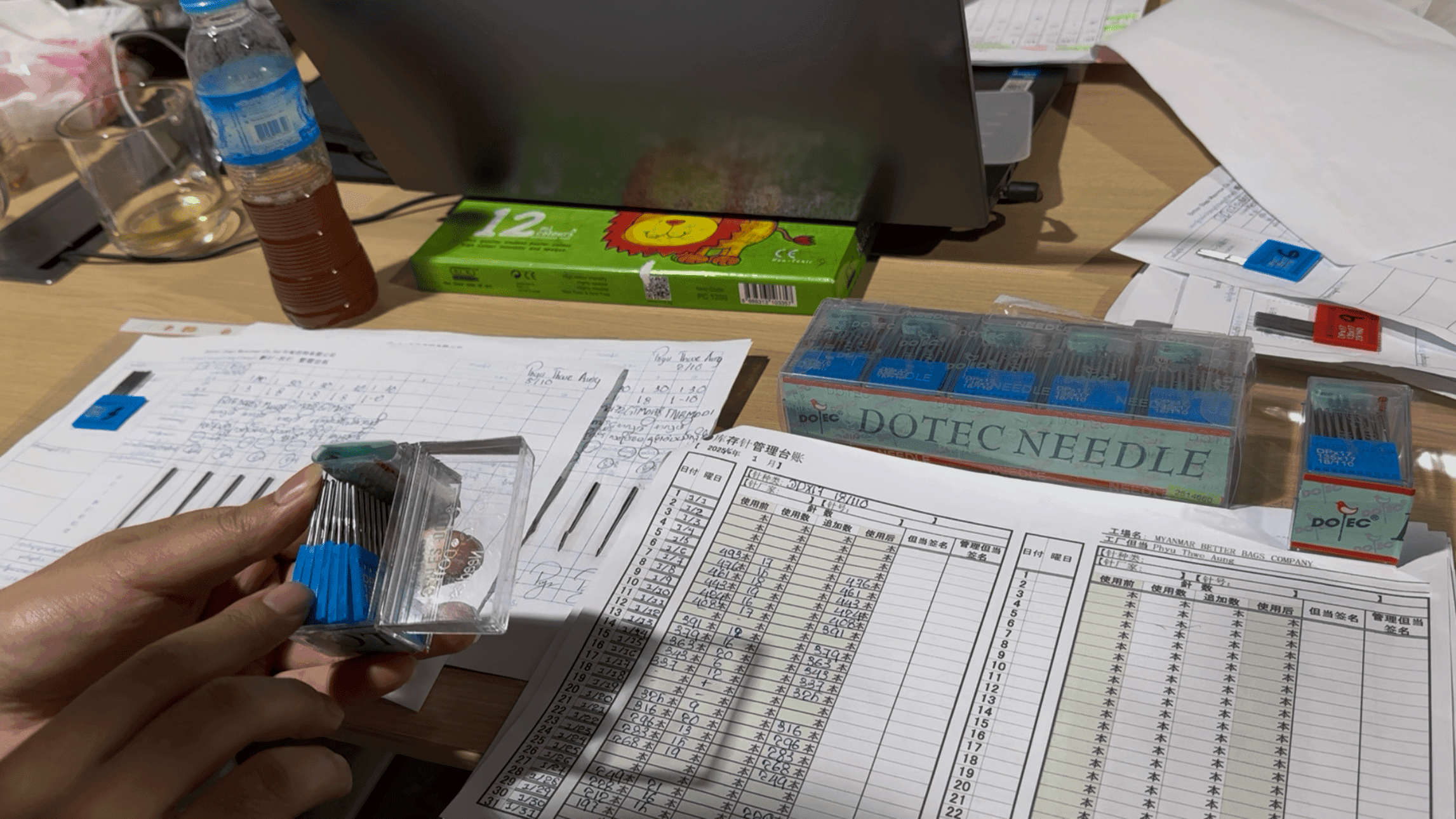
Cada línea de producción de la fábrica cuenta con su propio libro de registro, separado por tipo de máquina y tipo de aguja. La foto muestra el registro de una línea de ensamblaje en un día cualquiera.
El formato del libro de registro
El formato del libro de registro es el que hemos pulido junto con los clientes japoneses con quienes trabajamos desde hace muchos años. Sus campos son los siguientes:
| Campo | Significado |
|---|---|
| Nombre de la fábrica | MYANMAR BETTER BAGS COMPANY |
| Tipo de aguja | DPx17 18/110 (DOTEC NEEDLE, fabricada en Japón) |
| Fecha / día de la semana | El día en curso |
| Recuento inicial | Agujas entregadas a la línea al inicio de la jornada |
| Usadas | Agujas usadas ese día (incluidas las rotas; los fragmentos de cada aguja rota se recuperan y se pegan directamente en el libro de registro del día) |
| Recuento final | Agujas que quedan en la línea al cierre de la jornada |
| Firma del operario | El operario de esa línea |
| Firma del responsable | Doble verificación del jefe de línea / responsable de control de calidad (QC) |
La única regla
Antes de terminar el día deben cumplirse dos condiciones: que "Inicial = Usadas + Final" cuadre, y que todos los fragmentos de cada aguja rota estén pegados en el libro de registro del día. Mientras ambas no se cumplan, la jornada no se cierra.
Cuando una aguja se rompe, todos sus fragmentos se recuperan en el propio taller y se pegan directamente en el libro de registro del día. Si falta aunque sea un solo fragmento, se vuelve a revisar la línea completa; y, si hace falta, no dudamos en reinspeccionar todas las piezas producidas ese día.
Pegar físicamente los fragmentos en el libro es una práctica sencilla, pero nos aporta dos cosas: (1) la visibilidad de que "basta contar para que cualquiera lo confirme de un vistazo" y (2) la trazabilidad de tener el papel y la evidencia física en el mismo lugar cuando repasamos los registros de lotes antiguos.
Un día de control de agujas rotas: la línea de tiempo
En la página derecha del libro de la foto se alinean las anotaciones diarias de un operario durante un mes: 493 agujas, 476, 463, 458, 461… una por una, todos los días.
No es un sistema vistoso. Pero haber sostenido durante 20 años eso de "una línea al día, ni una aguja fuera de lugar" es, también a nuestro propio juicio, la principal razón por la que las marcas japonesas mantienen con nosotros relaciones comerciales de largo plazo.
Segunda capa: inspección del 100% de las piezas con el detector de agujas X-ray
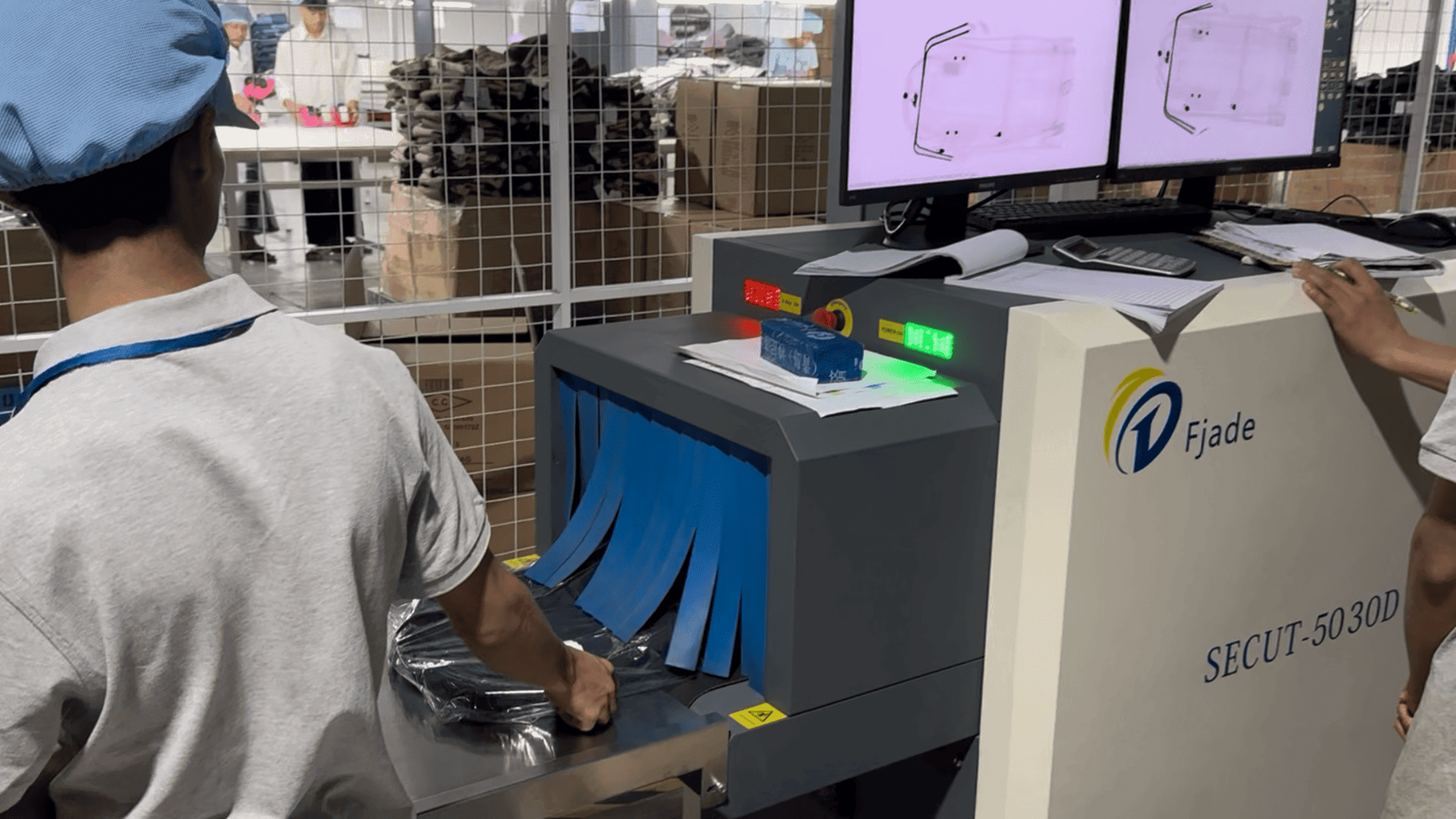
Por preciso que sea el libro de registro, mientras lo operen personas no se puede afirmar que el riesgo sea cero. Precisamente por eso, para ese "y si", mantenemos una línea de defensa adicional.
Se trata de la inspección del 100% de las piezas antes del envío, realizada con los 2 detectores de agujas X-ray (uno de ellos un Fjade SECUT-5030D) instalados en nuestra fábrica de Yangon, Myanmar.
El flujo de la inspección al 100%
- El producto terminado llega a la línea previa al embalaje
- Un operario pasa cada pieza, una por una, por la máquina X-ray
- En los monitores duales se confirma al instante si hay fragmentos metálicos
- Los componentes legítimos, como herrajes y cremalleras, están registrados de antemano en una base de datos
- Ante cualquier lectura metálica inesperada, la línea se detiene de inmediato
- Actuación ante una anomalía
- Se retiene la pieza afectada
- Se rastrea la línea hacia atrás hasta identificar la causa
- Se reinspecciona el lote completo
- Solo las piezas aprobadas se embalan y se envían
La inspección X-ray cuenta en total con 2 máquinas en la fábrica de Myanmar y 1 máquina en la fábrica de Shandong, China, con una regla de operación: "todo lo que se envía pasa por ellas, sin excepción".
El X-ray no es un "seguro", sino "un segundo documento maestro"
La inspección X-ray no es un "seguro": es "un segundo documento maestro" que se sitúa al mismo nivel que el libro de registro. Aunque los números del libro cuadren, si el X-ray lanza una sola alerta, el envío se detiene. Y a la inversa: aunque el X-ray marque cero, si el libro no cuadra, el envío también se detiene. Solo lo que supera ambas verificaciones al mismo tiempo llega a manos de nuestros clientes.
En qué nos diferenciamos de una fábrica típica
Aun así, en las reuniones nos preguntan a menudo: "en la práctica, ¿en qué son ustedes más estrictos que otras fábricas?". Lo resumimos en una tabla.
| Punto de gestión | Fábrica de costura típica | Better Bags Myanmar |
|---|---|---|
| Compra de agujas | Prioridad al costo (sin importar el origen) | Principalmente DOTEC NEEDLE de fabricación japonesa (con control por lote) |
| Libro de registro diario | Lo habitual es consolidar por semana o por mes | Una línea al día + doble firma (conciliación diaria) |
| Actuación ante una rotura | Basta con recuperar los fragmentos | La jornada no se cierra hasta recuperar todos los fragmentos (pegados directamente en el libro de registro del día) |
| Detección antes del envío | Por muestreo / parcial | Inspección X-ray del 100% de las piezas (2 máquinas en Myanmar, incluida una Fjade SECUT-5030D + 1 en Shandong, China) |
| Conservación de registros | Alrededor de 1 año | Por lote, 5 años o más |
| Auditorías de terceros | Preparación improvisada cada vez / no disponible | Atención inmediata con solicitud previa |
"Mantener un libro de registro discreto durante 20 años es más difícil que comprar una máquina vistosa": esa es la valoración que más recibimos de nuestros clientes japoneses.
Registros conservados 5 años o más — "Después, siempre se puede rastrear"
El libro de registro y los historiales de la inspección X-ray se vinculan por lote de fabricación y se conservan durante 5 años o más.
Lo hacemos para poder responder en todos estos casos:
- cuando un cliente nos consulta: "aquel lote, quisiera verificarlo por si acaso";
- ante una auditoría de terceros (BSCI / SEDEX / auditorías propias de cada marca);
- y si, en el caso improbable de un reclamo de mercado, hay que rastrear la causa hasta su origen.
"Cuándo, en qué línea, quién, con qué aguja, qué producto se fabricó, cuándo y por qué máquina X-ray pasó, y a qué hora se envió": mantener toda esa cadena en un estado que pueda reconstruirse solo con los documentos. Ese es el contenido de lo que llamamos "calidad japonesa".
Por qué llegamos tan lejos
Con franqueza: un control de agujas tan estricto encarece, sin duda, el costo de fabricación. El tiempo de anotar el libro de registro, la doble verificación de los jefes de línea, el mantenimiento de los detectores X-ray, el riesgo de detener una línea.
Si aun así mantenemos este sistema, es porque durante más de 20 años nuestros clientes japoneses — socios de largo plazo como Anello※3 — han esperado de nosotros este nivel "como algo natural".
Y porque nadie sabe mejor que nosotros que una relación solo dura 20 años cuando se responde, una y otra vez, a lo que el cliente da por sentado.
Aunque en 2023 trasladamos el centro de nuestra fabricación a Yangon, Myanmar, hay algo que no ha cambiado: "mirar con los ojos más exigentes lo que ocurre donde el cliente no puede ver", la actitud que mantenemos desde nuestra fundación.
En resumen
| Punto | Lo que hacemos |
|---|---|
| Compra de agujas | DOTEC NEEDLE (fabricación japonesa, con control por lote) |
| Gestión diaria | Libro de registro de inventario de agujas: por línea, una línea al día, doble firma |
| Ante una aguja rota | La jornada no se cierra hasta recuperar todos los fragmentos; los fragmentos se pegan directamente en el libro de registro del día (papel y evidencia física gestionados como una sola cosa) |
| Inspección antes del envío | Inspección X-ray del 100% de las piezas (2 máquinas en Myanmar, una de ellas una Fjade SECUT-5030D + 1 en Shandong, China) |
| Conservación de registros | Por lote, 5 años o más |
| Alcance | Todo lo que se envía desde la fábrica de Myanmar y todo lo que se envía desde la fábrica de China |
| Auditorías de terceros | BSCI / SEDEX / auditorías propias de cada marca: todas atendidas |
Proteger la operación de nuestros clientes es nuestro trabajo más importante
Nada arrebata la confianza en una marca tan rápido como que aparezca dentro de un producto "algo que nunca debió estar ahí".
Seguiremos incorporando nuevos equipos, nuevos estándares y nuevas opiniones de nuestros clientes, y sumando día a día ese "ni una sola aguja se nos escapa".
Para consultas, visitas a la fábrica o solicitudes de muestras, cualquiera que sea su pregunta, por favor no duden en contactarnos.
Fuentes
- ※1 Ley de Responsabilidad por Productos (Ley PL, Ley n.º 85 de 1994). Ley que establece la responsabilidad indemnizatoria del fabricante cuando un defecto del producto causa daños a la vida, la integridad física o el patrimonio.
- ※2 Normas de seguridad de juguetes establecidas por la Asociación Japonesa del Juguete. Pueden aplicarse a bolsos infantiles, carteras escolares y artículos similares.
- ※3 Anello Co., Ltd. es una de nuestras empresas socias de largo plazo. El uso de su nombre en este artículo se publica con confirmación previa.
Artículos relacionados
【Serie Calidad】Artículo hermano
- 【Vol.02】 Una segunda mirada, con ojos de terceros — La "calidad japonesa 100%" en los envíos desde Myanmar, lograda junto a I-pack — una capa más de inspección de terceros, por encima de nuestra inspección interna.
【Serie Fábrica】
Sobre el autor
Como líder de la nueva generación de Better Bags —un fabricante familiar con visión global—, cuento con más de 8 años de estudios y experiencia profesional en Pensilvania, Estados Unidos. Como exalumno de Penn State University y Carnegie Mellon University, me enorgullece aportar a nuestros clientes y socios una experiencia internacional comprobada y habilidades de comunicación intercultural. Mi misión es unir lo mejor de Oriente y Occidente, para que cada socio disfrute de productos de primera calidad, una comunicación fluida en cada proyecto y un servicio posventa confiable, sin importar en qué parte del mundo se encuentren.